



Akinbode Akinbiyi at the Venice Biennale 2026
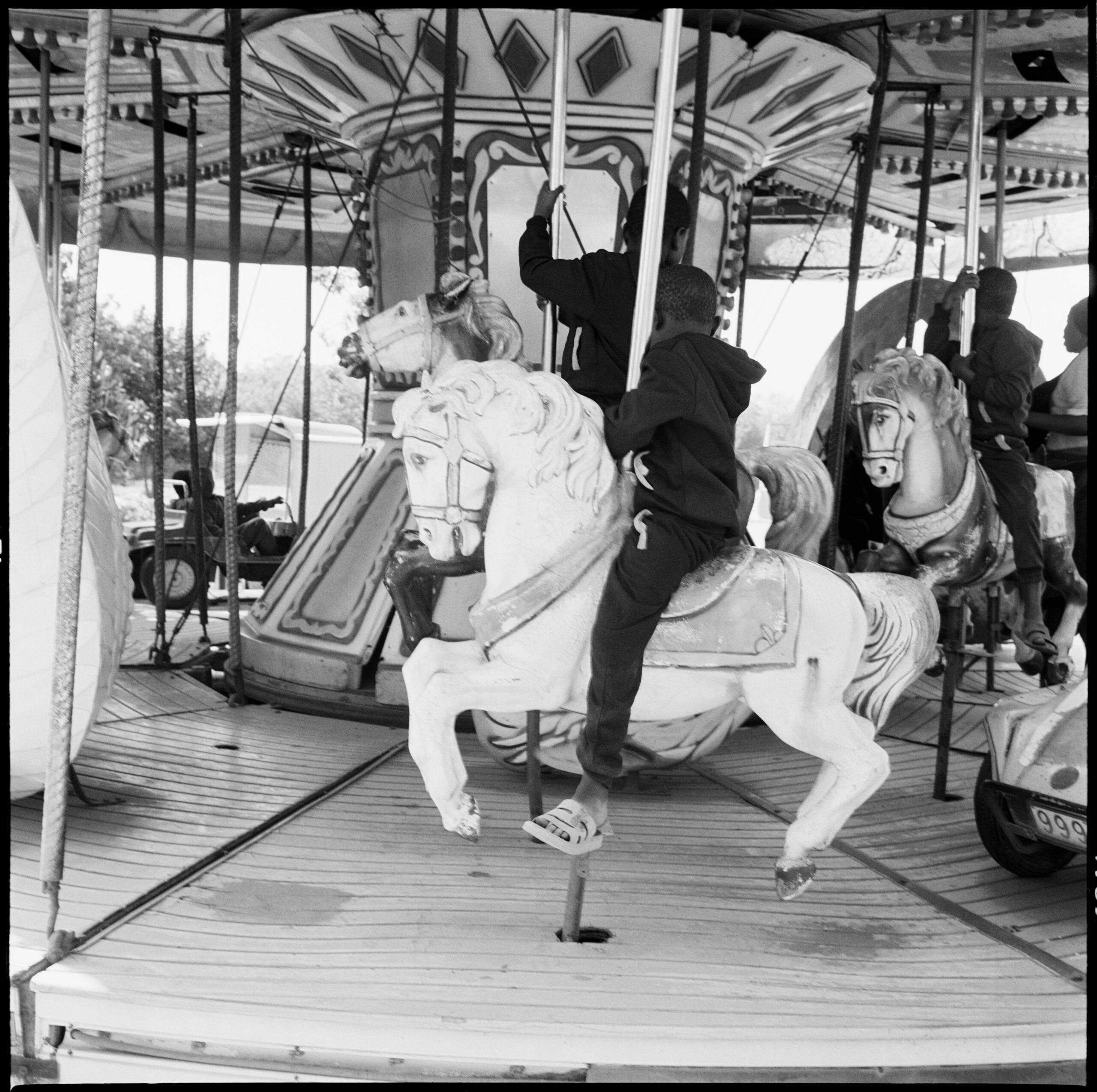
With the 61st International Art Exhibition of La Biennale di Venezia, the international art world is turning its attention more than ever to African perspectives. Thirteen African countries are presenting national pavilions, with four participating for the first time. The exhibition In Minor Keys, conceived by Koyo Kouoh, foregrounds new narratives, collective memory, and the question of who gets to tell cultural stories.
In Venice, this does not only expand the geographical scope of the Biennale; it also reconfigures its institutional framework. This year’s edition has become a space where global power relations within the art world are both more visible and more critically questioned. African and diasporic positions are no longer peripheral additions, but shaping forces within the curatorial structure.
In this context, we are especially pleased that our curator Akinbode Akinbiyi is presenting work at the Biennale this year. His presence reflects an artistic practice that goes beyond representation, actively contributing to the expansion of discursive spaces—between local contexts and international institutions. This perspective is closely connected to our work at the Opera Village. We do not understand art as a closed exhibition space, but as a social process that creates relationships, shares knowledge, and experiments with new forms of togetherness.
At the core of our Artist-in-Residence programme is therefore direct exchange between international artists and local communities in Burkina Faso. This collaboration does not follow a top-down logic, but is based on mutual learning and an open, often experimental process. Here, art is understood as something that emerges from encounter, not from distance.
This year’s Biennale makes clear how strongly such approaches are becoming embedded in the global art system. In Minor Keys shifts the focus away from a single dominant narrative towards a multiplicity of voices that deliberately embraces contradiction, rupture, and diverse lived experiences. The exhibition itself thus becomes a space of negotiation—both aesthetic and political, as well as institutional.
For us at the Opera Village, this development is closely aligned with our own practice. The participation of Akinbode Akinbiyi in Venice reflects an understanding of art as a relational process—something that only comes into being through interaction: between artists, contexts, and communities.
The Venice Biennale of 2026 makes very clear what we at the Opera Village have been working towards for many years: that new cultural narratives do not emerge through visibility alone, but through relationships, shared processes, and spaces in which different perspectives can be negotiated on equal terms.
Header image: © Akinbode Akinbiyi, Ouagadougou, Burkina Faso; 2021
